You’ve probably heard a lot about 5G over the past few years, but the discussion is usually around what it can do for your cellphone, not your home internet. But if you’re moving to a bigger city and looking for a new internet provider, 5G might be your best option. 5G plans have no contracts, simple all-in-one pricing, and plenty of speed for most homes. It works the same way it does with your phone: data is sent back and forth from cell towers to your home instead.Up until now, that cellular connection wasn’t quite strong enough to support your whole home. But with 5G — the fifth generation of wireless data networks — speeds are similar to what you’d get with other types of internet service. The main difference is that 5G home internet is completely wireless, while cable, fiber, and DSL internet all use wired connections. That doesn’t mean you can take your 5G home internet anywhere, though — it’s still fixed at your address.
There’s a lot to love about Verizon’s 5G Home internet service. It gets the fastest speeds of any 5G internet provider, the price is great (and locked in for at least three years), and there are no contracts or hidden fees. You’ll probably be able to find faster internet with a cable or fiber provider, but that’s the case with all 5G internet. Where it closes the gap is with its simple, all-in-one pricing. Unless you have a bigger household that connects a lot of devices at once, you’ll likely be fine with Verizon’s 25 – 1,000 Mbps speeds. Note that the Home Internet Lite plan comes with a 150 GB data limit, after which your speeds will be slowed to 10 Mbps download and 3 Mbps upload.Verizon’s 5G Home internet service is currently available to about 30 million households in 900 cities, with plans to expand to 50 million by 2025. Check availability
If you can’t get Verizon 5G Home internet at your address, don’t worry — Starry Internet offers virtually the same price and speed. You’ll get 200 Mbps download and 100 Mbps upload speeds, which is plenty for most households. (Starry also offers faster and slower plans at some addresses.)Starry uses a fixed wireless network, which sends signals directly to and from your home, while wireless carriers like Verizon and T-Mobile send signals in every direction. That should theoretically translate to faster internet, especially at congested times of day.Currently, Starry Internet is only available in six cities: Boston, Columbus, Denver, Los Angeles, New York City, and Washington, DC. That said, it has big plans for expansion, and aims to reach 25 million households by 2026.Check availability
T-Mobile 5G Home: Best availability
| Feature | Rely Home Internet | Amplified Home Internet | All-In Home Internet |
| -------------- | ------------------ | ----------------------- | -------------------- |
| Price* | $30/mo.** | $40/mo.** | $50/mo.** |
| Download speed | 133 - 415 Mbps | 170 - 498 Mbps | 170 - 498 Mbps |
| Upload speed | 12 - 55 Mbps | 12 - 55 Mbps | 12 - 55 Mbps |
| Data cap | Unlimited | Unlimited | Unlimited |
| Price lock | 5 years | 5 years | 5 years |*Prices updated 11/14/25.
**w/AutoPay, a T-Mobile postpaid voice line. Plus taxes and fees. Price with $15/monthly bill credit. Delivered via 5G cellular network; speeds vary due to factors affecting cellular networks, including data prioritization. Not available in all areas. Limited time. Subject to change.Pros
Equipment included
$500 contract buyout
Cons
Slightly slower than other 5G internet
Right now, T-Mobile is available to around 50 million households across the country — far more than any other 5G home internet provider. While Verizon and Starry are primarily available in cities, T-Mobile is actually a viable option in many rural and suburban areas, too. But with that expanded coverage comes a slight drop in speed. It’s available to more people because it partially relies on T-Mobile’s 4G LTE network in addition to its growing 5G network. It still provides much faster speeds than DSL or satellite, but it’s not quite on the same level as Starry or Verizon.That said, 5G internet speeds are highly dependent on your location, and the only way to know for sure what you’ll get is to try it out. Fortunately, T-Mobile gives you 15 days to decide if you like the service, or you’ll get your money back. Check availability
5G home internet availability
5G is the new kid on the block when it comes to home internet service, and that means coverage is constantly expanding. It’s very possible that your home could have some new internet options to choose from over the next year. Verizon expanded coverage to 30 million households earlier in 2022, and plans to reach 50 million by 2025. T-Mobile recently upped its total to 40 million households, a third of which it says are located in rural areas. Starry is the smallest 5G internet provider with coverage in only six cities, but says it plans to expand to “more than 40 million households nationwide.”
5G vs. other internet types
5G is a type of internet connection that’s usually classified as “fixed wireless.” Instead of cable or phone lines delivering the internet, fixed wireless uses broadcast towers to send and receive signals. But while older generations of fixed wireless internet were slower — and required installing a dish or antenna on the outside of your house — new 5G internet providers get much faster speeds and use a smaller gateway device inside the home.Because 5G internet is wireless, speeds are a little more variable than they are with a wired connection like cable or fiber. The closer you are to a 5G tower or node, the better your connection is going to be. Fortunately, each provider gives you a trial period to test it out for yourself.
Verizon Fios key features
- Price: $34.99 - $94.99/mo. with mobile plan
- Speed: 300 Mbps - 2.3 Gbps
- Contract: None
- Data caps: None
Fios by Verizon is the brand name for Verizon’s fiber internet plans. Thes are different and offer speeds faster than Verizon’s DSL internet plans, which are...
Spectrum key features
- Price: $30 - $90/mo.
- Speed: 100 Mbps - 2 Gigs (in select areas)
- Contract: None
- Data caps: None
With a business reach that spans 41 states, Spectrum is one of the largest internet service providers out there, covering over 27% of the U.S. population. Owned by...
Astound key features
- Price: $30.00 – $90.00/mo.
- Speed: 300 – 2,000 Mbps
- Contract: None
- Data caps: None
- Good coverage in rural areas
- No contracts
- No data caps
- Different speeds available depending on your location
- Prices can increase significantly after promo...

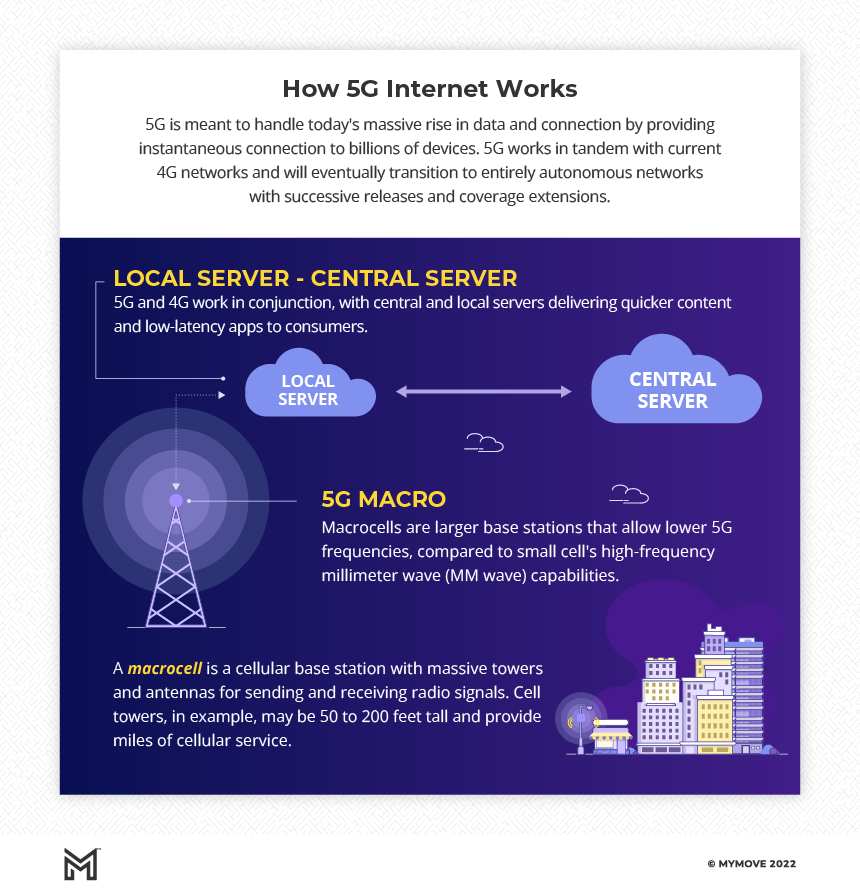 5G is a type of internet connection that’s usually classified as “fixed wireless.” Instead of cable or phone lines delivering the internet, fixed wireless uses broadcast towers to send and receive signals.
But while older generations of fixed wireless internet were slower — and required installing a dish or antenna on the outside of your house — new 5G internet providers get much faster speeds and use a smaller gateway device inside the home.
Because 5G internet is wireless, speeds are a little more variable than they are with a wired connection like cable or fiber. The closer you are to a 5G tower or node, the better your connection is going to be. Fortunately, each provider gives you a trial period to test it out for yourself.
5G is a type of internet connection that’s usually classified as “fixed wireless.” Instead of cable or phone lines delivering the internet, fixed wireless uses broadcast towers to send and receive signals.
But while older generations of fixed wireless internet were slower — and required installing a dish or antenna on the outside of your house — new 5G internet providers get much faster speeds and use a smaller gateway device inside the home.
Because 5G internet is wireless, speeds are a little more variable than they are with a wired connection like cable or fiber. The closer you are to a 5G tower or node, the better your connection is going to be. Fortunately, each provider gives you a trial period to test it out for yourself.